
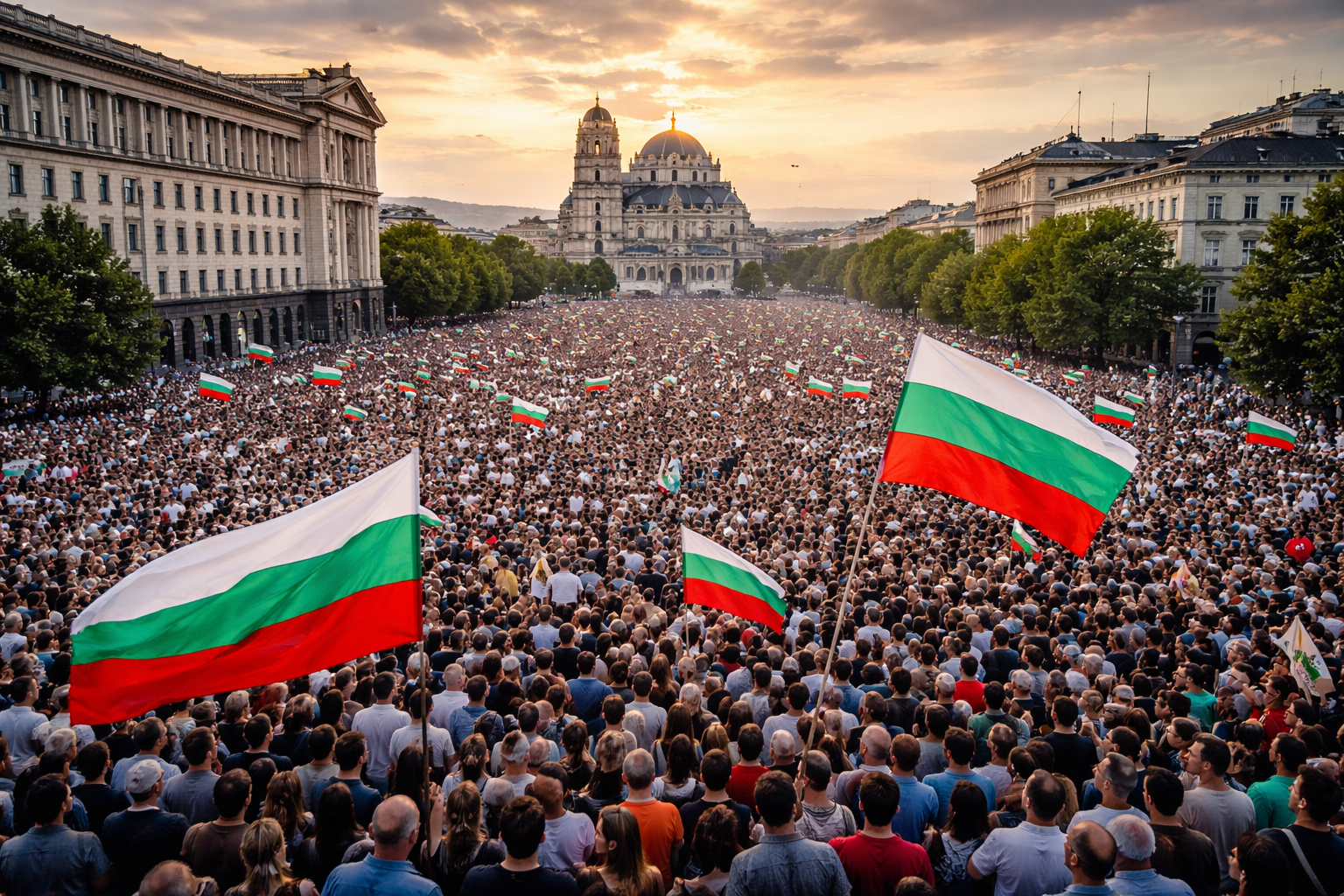
Just weeks before Bulgaria prepares to adopt the Euro, its government is falling apart. Streets are full, parliament is paralysed, and the state is heading for yet another snap election.
Bulgaria’s corruption crisis is not sudden. It is the logical outcome of years of unresolved power struggles, weak courts, and a public that no longer believes the system can correct itself.
A government collapses at the worst possible moment
In December, tens of thousands of Bulgarians filled central squares in Sofia and other cities.
The immediate trigger was a draft 2026 budget that raised taxes and social security contributions while increasing state spending.
The government withdrew the plan after protests, then lost control of events anyway.
Prime Minister Rosen Zhelyazkov offered his resignation, and the parliament accepted the resignation days later.
The timing could not be worse. Bulgaria is scheduled to adopt the euro on January 1, 2026.
That requires a functioning government, a clear budget framework, and public confidence in regulators. Instead, the country is heading toward caretaker rule and an early election.
President Rumen Radev is expected to appoint an interim cabinet, making this the eighth national vote since 2021.
For ordinary Bulgarians, the message is simple. Every major decision seems to end in collapse.
Even a currency change meant to establish stability has become another stress point.
Why the budget protests turned into a system revolt
The protests were never really about one budget. They were about who pays and who benefits in a country where trust is thin.
In fact, Bulgaria is the poorest member of the European Union by most measures.
Eurostat data for 2024 shows GDP per capita at about two-thirds of the EU average.
Around 30% of Bulgarians are at risk of poverty or social exclusion, the highest share in the bloc.
In that context, tax hikes land differently. People do not see shared sacrifice. They see a system that protects insiders first.
Protesters demanded fair elections and an independent judiciary.
That choice of words is important because many Bulgarians no longer believe elections alone can fix corruption if courts and prosecutors are seen as politically captured.
This is why the protests did not stop when the budget was withdrawn. The budget was proof of something larger.
The idea that decisions are made inside closed networks and presented to society as unavoidable facts.
The long shadow of oligarch power
No figure symbolises that belief more than Delyan Peevski. Sanctioned by the United States in 2021 under the Magnitsky Act and later by the United Kingdom, Peevski is widely viewed as a power broker whose influence cuts across parties, media, and security services.
His party backed the outgoing coalition led by the GERB party of former prime minister Boyko Borissov.
For protesters, Peevski represents continuity without accountability. Governments change, coalitions shift, but the same names remain influential.
This perception has deep roots. In 2013, Peevski’s brief appointment to head Bulgaria’s counterintelligence agency sparked mass protests that lasted nearly a year. More than a decade later, the pattern feels familiar.
Bulgaria ranks near the bottom of the EU on corruption perception and press freedom according to Reporters Without Borders.
These rankings affect how citizens interpret every political move. When trust is gone, even routine governance looks suspicious.
Elections that no longer reset the system
Bulgaria has held seven elections in four years. That alone signals a broken political loop.
Coalitions form to survive parliament rather than to govern. Reformist parties win votes but struggle to stay united. Established parties return because they are organised and patient.
Protesters now openly question election integrity. Concerns about vote buying and result manipulation were common chants at December rallies.
That is a serious shift. Elections are supposed to absorb anger and restore legitimacy. When they are seen as compromised, anger spills into the streets instead.
The irony is that Bulgaria has a politically engaged population. Turnout in protests is often high. What is missing is the belief that participation leads to durable change.
Young people have been leaving the country in large numbers for years. Many stayed away from demonstrations until recently. Their return to the streets signals frustration rather than renewed optimism.
The euro dilemma and what it reveals
Joining the eurozone should be a technical step after years of preparation. In Bulgaria, it has become political.
Support for adopting the euro remains low. Surveys show fewer than four in ten Bulgarians back the move.
Trust is the issue. People worry about price rises during the transition and doubt the state’s ability to enforce fair practices.
These fears are not irrational. In countries with strong regulators, euro adoption usually brings limited disruption.
In countries where enforcement is weak, businesses can exploit confusion. Bulgarians know this.
The euro debate exposes a deeper truth. Monetary integration assumes institutional competence.
Bulgaria is trying to leap into that framework without having fixed the basics at home.
For the European Union, this matters. Bulgaria has been a member since 2007. Its struggles challenge the idea that time inside the EU automatically produces strong institutions.
They also raise uncomfortable questions about how readiness is judged when political reality diverges from technical criteria.
Bulgaria’s crisis is not loud because of chaos. It is loud because of repetition. Governments fall. Elections follow.
The same arguments return. The euro clock keeps ticking. What looks absurd from the outside feels exhausting from the inside.
The post How Bulgaria’s corruption crisis has paralysed its government appeared first on Invezz