
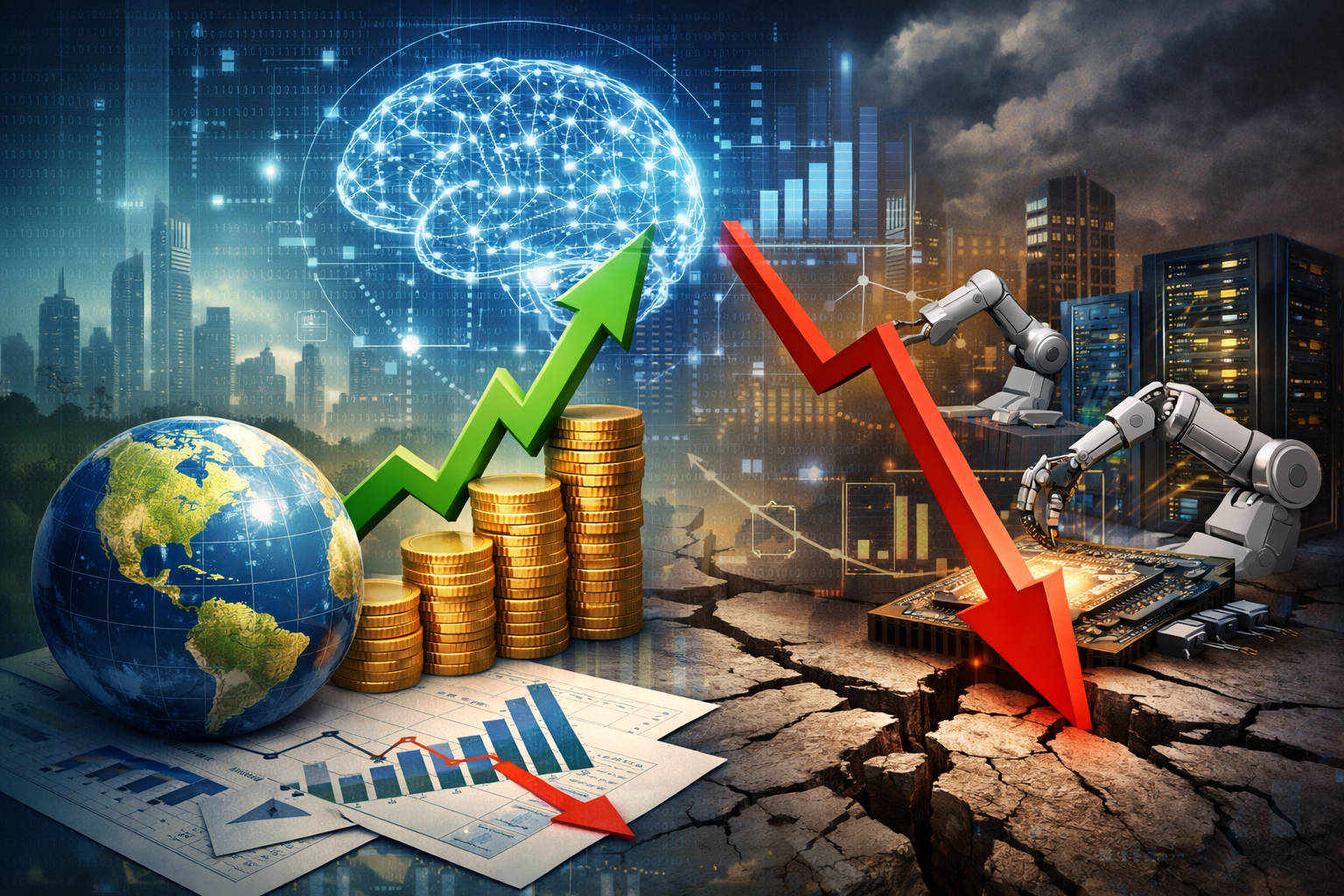
The global economy is set to expand more than expected, according to the International Monetary Fund.
But even with stronger forecasts, the IMF warns that financial risks linked to artificial intelligence, trade shifts, and geopolitics remain.
Rapid changes in tech investment and market momentum could lead to instability if expected gains fail to materialise.
While growth appears steady for now, underlying vulnerabilities still pose challenges for the months ahead.
Uncertainty around monetary policy, shifting supply chains, and concentrated sectoral growth could all affect the pace of recovery, especially if external shocks disrupt financial conditions or investor confidence.
AI spending supports growth but brings risks
The IMF now expects the global economy to grow by 3.3% this year, slightly above its earlier forecast of 3.1% from October.
The updated figures were released on Monday in the latest World Economic Outlook.
The report points to rising business activity and strong investment in AI technologies as key factors behind the upgrade.
AI development has sparked a surge in market confidence, particularly in North America and Asia.
The stock market has gained momentum as firms increase spending on emerging tech.
However, the IMF has warned that this boom could become a risk if productivity gains fail to appear.
A market downturn triggered by failed expectations could spread across industries and hurt household wealth.
The report highlights how concentrated investment in AI leaves economies more exposed to financial volatility.
An abrupt shift in confidence could lead to broader losses, adding pressure to already fragile economic structures.
Tensions in trade and geopolitics still a concern
While the impact of recent tariffs is expected to ease over time, the IMF remains cautious.
It notes that new trade disputes could still emerge, especially as more governments move toward protectionist policies.
Such developments would reduce company profits and keep prices elevated for longer.
Although recent months have seen some improvement in global trade flows, these gains could be reversed.
Persistent geopolitical tensions are also flagged as a risk that could affect investment decisions and cross-border supply chains.
Regional outlooks show mixed trends
The IMF projects that the US economy will grow by 2.4% in 2026, higher than the 2.1% forecast made in October.
This is attributed to supportive fiscal policy and an expected reduction in interest rates.
Growth is likely to slow to 2% in 2027, as consumer spending and immigration levels moderate.
For the euro area, growth is forecast at 1.3% this year, while China’s economy is expected to expand by 4.5%.
These regions continue to play a significant role in global growth, with China’s domestic recovery making a substantial contribution to the overall outlook.
The IMF’s longer-term forecast for global growth in 2027 remains unchanged at 3.2%.
Markets show resilience amid underlying fragilities
Despite challenges, the IMF notes that the world economy has adapted well in recent years.
But it also cautions that underlying weaknesses remain, particularly in areas with high exposure to the tech sector.
The report urges caution as AI-related gains may not be as durable as markets expect.
The potential for sudden financial shocks tied to AI investment highlights the need for careful policy monitoring.
According to the IMF, while AI offers economic promise, it also introduces structural risks that should not be ignored.
The post IMF sees global growth rising but warns of AI-driven market risks appeared first on Invezz