
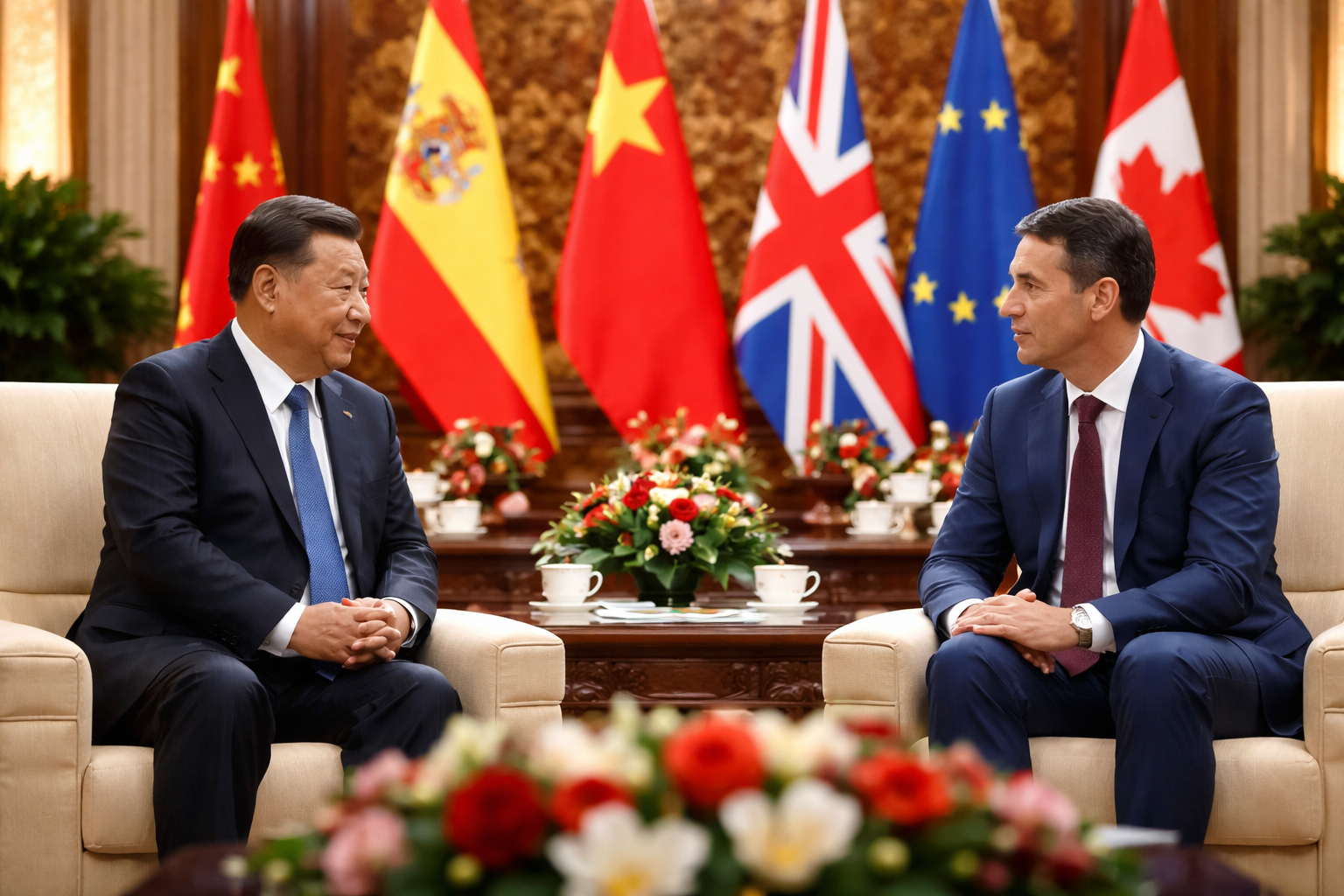
On Tuesday, April 14, 2026, Spanish Prime Minister Pedro Sanchez sat across from Xi Jinping in the Great Hall of the People in Beijing and declared that Europe and China must forge closer ties to counter threats to multilateralism.
Xi, for his part, told Sanchez the international order is “crumbling.”
Two days later, Vietnam’s president arrived in Beijing for a state visit. Leaders from Britain, Canada, Finland, and Ireland had already made the same trip this year.
Perhaps the parade of Western and non-Western capitals turning toward Beijing is not a coincidence.
Xi said the quiet part out loud
World leaders rarely describe the international system as “crumbling” in bilateral press settings. What Xi is pointing at is that the rules-based order the United States built after 1945, anchored in the UN, the WTO, NATO, and dollar dominance, is losing its organising force.
Countries no longer trust that the architect will follow their own blueprints.
The timing is precise, as it came during a period when Brookings researchers have confirmed that US trade policy is the most restrictive in over 110 years.
It came as Spain publicly refused to allow US-shared military bases on its territory to be used for strikes on Iran.
How the economic map explains the diplomatic map
To understand why Spain, Vietnam, the UAE, and Canada are all turning toward Beijing in the same quarter, you need to understand what has happened to the global economic architecture over two centuries.
In 1700, China accounted for roughly 33% of global GDP, India another 24%.
The Industrial Revolution transferred that weight westward at extraordinary speed.
By 1945, the United States produced close to half of global output, a concentration without precedent.
That dominance produced a specific world order: the dollar as reserve currency, Bretton Woods, open maritime trade routes, and an alliance network that turned American hegemony into something that looked, to most of its members, like a rules-based system worth belonging to.
That logic is now fraying from the inside.
The average American household paid roughly $1,500 more in 2026 as a direct result of Trump’s tariffs, with Goldman Sachs estimating 88% of the cost was absorbed by US consumers and businesses, not foreign exporters.
Manufacturing employment fell by 10,000 jobs in the first half of 2025 despite the highest tariff wall in a century.
The manufacturing renaissance has not materialised.
What has materialised is an accelerating decoupling from China that has, paradoxically, expanded China’s trade surplus with the rest of the world as its manufacturers redirected exports to new markets.
What Spain’s visit to Beijing actually signals
Sanchez’s trip is being reported as a bilateral trade visit. Beijing agreed to narrow Spain’s nearly $50 billion trade deficit with China, and both sides signed deals on agricultural exports and infrastructure.
But the visit signals something structural.
Spain is a NATO member hosting US military bases.
Its Prime Minister flew to Beijing to say, publicly, that Europe must treat China as a strategic partner rather than the geopolitical rival defined by Washington, and that the US has withdrawn from climate, security, and equality agendas that matter to middle powers.
This is precisely the diplomatic opening China’s “four perspectives” doctrine is designed to capture, positioning Beijing as the defender of international law, sovereign equality, and multilateral institutions, the exact vocabulary the US used to describe itself for 75 years.
Whether China’s own record on sovereignty is consistent with that rhetoric is a legitimate question.
But for middle powers watching Washington impose tariffs on allies and adversaries alike and treat the WTO as optional, China’s language is proving useful.
The one policy with genuine strategic logic
The Trump administration’s AI strategy stands apart from the tariff agenda.
The $500 billion Stargate initiative to build AI infrastructure across the US has clear strategic coherence.
Trump said at the announcement, “China is a competitor. We want to keep this in this country.”
The logic is sound. AI will define military capability and economic productivity for the coming decades in ways that parallel what industrial capacity meant in the 19th century and financial dominance in the 20th.
But the race is closer than Washington’s confidence suggests.
According to Epoch AI’s Capabilities Index, every frontier AI model since 2023 has been American, yet Chinese models have trailed US capabilities by an average of just seven months, with the gap narrowing as low as four months.
China has pursued an open-source strategy, publishing model weights publicly so developers can build on existing work rather than starting from scratch, which has compressed development timelines significantly.
The US leads on raw capability and controls the chip supply chain through Nvidia and export restrictions on Dutch manufacturer ASML.
China leads on robotics, accounting for 90% of global humanoid robot exports, though those robots still depend on AI software, where the US holds the edge.
What history says about tariffs and dominance
Economic history offers a clear answer on whether tariffs rebuild industrial power.
They do not, at least not efficiently enough to compete with countries industrialising from a lower wage base with state capital and long time horizons.
What built American hegemony was public investment in research, deep capital markets, global talent, and the dollar’s reserve status.
That reserve status now faces a structural contradiction.
The dollar’s global role depends on other countries wanting to hold and transact in dollars, which requires the US to run trade deficits because foreign countries need dollars to flow outward.
A sustained campaign to eliminate the trade deficit is incompatible with maintaining dollar hegemony. Britain tried to manage this same contradiction in the interwar period.
It ended the pound’s global primacy within a generation.
The crumbling Xi described is already in progress
The post-1945 order rested on American credibility as much as American power.
Credibility means allies trust you will follow the rules you wrote, and neutral countries see more value inside your system than outside it.
When the architect imposes tariffs on allies without distinction, withdraws from its own institutions, and oscillates between maximum pressure and 90-day pauses on a weekly cycle, credibility drains faster than military or economic power does.
Spain, Vietnam, Canada, and the UAE are not abandoning the West.
They are hedging against uncertainty, doing exactly what states have done in every previous hegemonic transition.
That means diversifying relationships and listening carefully to whoever offers the most stable framework for global engagement.
Right now, that offer is being made from Beijing, with growing confidence, and it is being heard across NATO members, Gulf states, and Southeast Asian capitals simultaneously.
That is the most consequential diplomatic development of 2026 so far.
The post From Spain to Canada: why are world leaders turning to China? appeared first on Invezz