
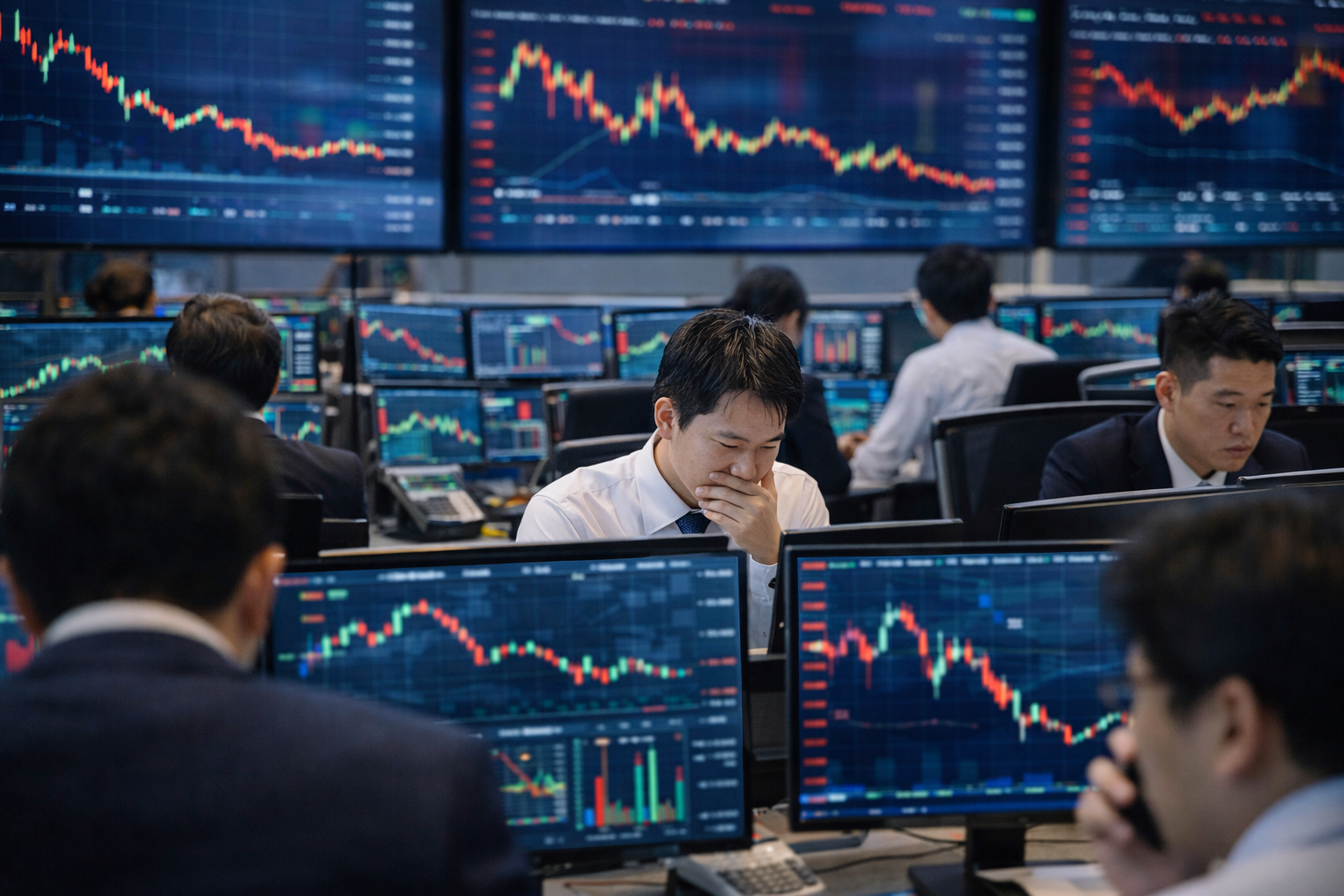
South Korean stocks recovered from an early decline on Friday while Japan’s Nikkei 225 fell, putting the region’s two semiconductor-heavy markets on different tracks ahead of a US jobs report that could reset expectations for interest rates and bond yields.
The KOSPI opened 0.47% lower before reversing to trade 0.24% higher at 6,977.07 by 11:20 am in Seoul.
Samsung Electronics edged up 0.09% and SK Hynix gained 0.44%, helping stabilise the index after Thursday’s 1.95% jump.
Foreign selling remained a constraint, while domestic investors provided support.
KOSPI finds support in the memory trade
Thursday’s rebound had been driven by renewed confidence in the global memory cycle after Micron’s strong earnings and guidance.
Samsung Electronics closed that session 2.79% higher and SK Hynix gained 3.21%, while South Korean semiconductor exports surged 262.8% from a year earlier in September.
The bigger question is whether that earnings story can draw foreign investors back. Seoul has struggled with sustained overseas selling as US yields and dollar strength raise the relative cost of holding Korean equities.
A Macquarie sales note cited by MarketWatch this week argued that memory supply could become significantly tighter through 2027 and 2028, while the market may still be underestimating the value of long-term agreements secured by SK Hynix.
That gives the KOSPI a fundamental cushion, but Friday’s muted advance shows investors are still reluctant to chase the rally ahead of US payrolls.
Nikkei gives back part of Thursday’s surge
Japan moved the other way. The Nikkei 225 fell about 1% to 68,263.52 after its sharp rally a day earlier, with technology, automobile and pharmaceutical shares among the weakest groups.
SoftBank Group dropped 5.6%, Honda Motor lost 1.8% and Chugai Pharmaceutical fell 2.4%.
Japanese equities also face a more complicated domestic rates backdrop. Tokyo core inflation accelerated to 2.7% in September from 1.8% in August, above expectations, strengthening the case for additional Bank of Japan tightening.
TS Lombard strategists Davide Oneglia and Rory Green told MarketWatch that rising Japanese yields are increasingly encouraging domestic investors to keep capital at home rather than seek returns overseas.
Payrolls and oil keep both markets hostage to rates
The common risk for Seoul and Tokyo remains the global bond market.
The US 10-year Treasury yield eased to around 5.25% after touching 5.34%, its highest since 2002.
Friday’s payrolls report is expected to show about 90,000 new jobs in September and unemployment holding at 4.1%.
OCBC Group Research told The Wall Street Journal that elevated US yields could continue to support the dollar and pressure Asian currencies, while softer payrolls and lower yields would provide relief. The won was near 1,359 per dollar and the yen around 157.8.
Oil adds another layer. Brent traded around $102.60 and WTI near $93.14 after China restricted fuel exports and reports pointed to a larger US military presence in the Middle East.
Elsewhere, MSCI’s Asia-Pacific index outside Japan fell about 0.5%. Mainland China remained closed for Golden Week, while Nasdaq futures rose 0.3% and S&P 500 futures gained 0.1%.
The post KOSPI rebounds while Nikkei slides 1%: why Micron’s boost is not lifting Japan appeared first on Invezz