
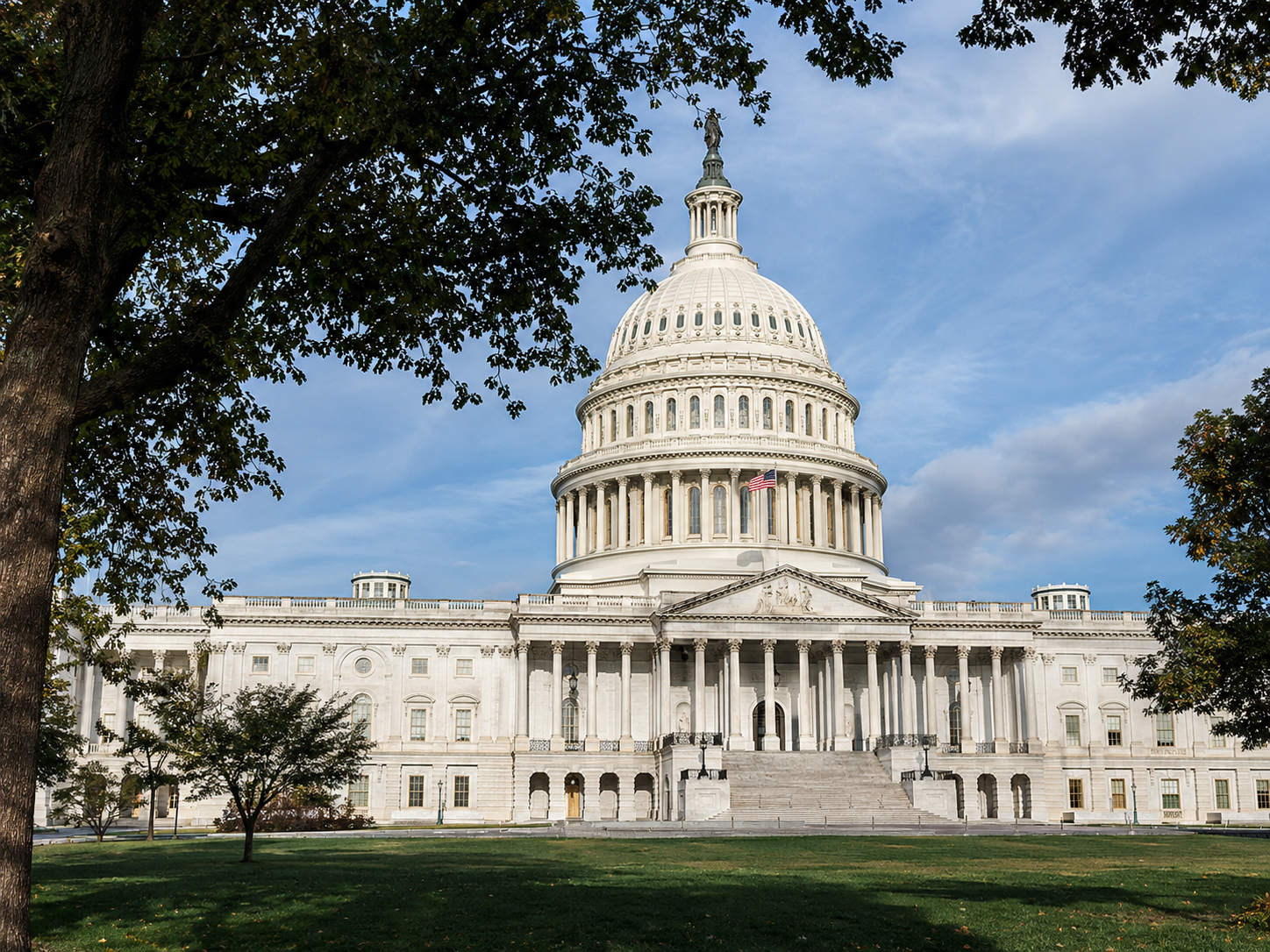
The US midterm elections are here, and they are taking place as investors grapple with rising government borrowing, elevated bond yields, trade policy uncertainty, and the prospect of tighter regulation.
The outcome could determine the balance of power in Congress for the next two years, with implications for fiscal negotiations, corporate oversight and some of Wall Street’s biggest investment themes, including artificial intelligence, clean energy, healthcare and defence.
Markets are particularly focused on the possibility of Democrats gaining control of both chambers of Congress.
Such an outcome could increase scrutiny of major technology companies and the rapid expansion of AI infrastructure, while potentially changing the outlook for government spending and regulation.
Prediction market traders see nearly 75% odds of Democrats taking the Senate.
UBS Chief Investment Officer Mark Haefele assigns a 50% probability to a Democratic sweep, a 40% probability to split control, with Democrats winning the House while Republicans retain the Senate, and a 10% probability that Republicans hold both chambers.
US stock futures were mostly down early on Tuesday as investors assessed Apple’s quarterly earnings and awaited the election results.
Dow Jones Industrial Average futures fell 0.59%, while S&P 500 futures traded down 0.07%. Nasdaq-100 futures rose 0.35%.
Could a Democratic victory weigh on AI stocks?
A Democratic victory in both chambers could bring increased oversight of the technology industry, particularly companies involved in developing frontier AI models and building the data centres needed to power them.
Investors have been betting on continued rapid growth in AI-related spending.
Any indication that policymakers intend to slow the expansion or impose additional compliance requirements could unsettle companies that have benefited from the infrastructure investment boom.
Raymond James Washington policy analyst Ed Mills said congressional investigations could accelerate efforts to introduce safety standards for frontier AI models, require independent evaluations and incident reporting, and make data-centre developers more accountable.
A Democratic-controlled Congress could also use its investigative powers to compel technology executives to testify under oath or provide records concerning harmful behaviour by AI agents.
The political pressure comes as public support for the pace of data-centre construction remains limited.
Only one in three Americans approve of the rapid expansion of data centres, according to a Reuters/Ipsos opinion poll.
Greater scrutiny could weigh on companies involved in data storage, memory and semiconductor equipment, particularly those whose valuations have benefited from expectations of sustained AI infrastructure spending.
Micron Technology, SanDisk and Seagate are among the companies that could attract investor attention given their exposure to the AI-driven expansion of data storage and memory demand.
A slowdown in data-centre investment or additional regulatory hurdles could also affect semiconductor-equipment makers.
Last month, Michael Hartnett, Bank of America’s chief equity strategist, said Democrats winning both the House of Representatives and the Senate could trigger a more than 10% fall in US stocks.
He said a Democratic takeover of Congress would constrain Trump’s ability to advance his policy agenda, including efforts to consolidate US control over strategic resources and maintain American supremacy in artificial intelligence relative to China.
The outcome could also affect investor expectations for government support of the AI industry, trade policy and the broader business environment.
However, UBS does not expect a change in congressional control to derail the expansion of data centres, given that many relevant decisions are taken at state and local levels.
“The most visible effects of a change in congressional control would likely be greater oversight of the administration and more difficult fiscal negotiations,” Haefele said.
He added: “We do not expect a change in congressional control to derail data center expansion, since many relevant decisions are made at state and local levels. So, we would not treat the midterms as a binary directional event for equities, bonds, or the dollar.”
Debt negotiations and government spending could unsettle markets
Fiscal policy is another major concern for investors, particularly as the US government faces large deficits and rising interest costs.
A Democratic-controlled Congress could soften or delay some proposed spending cuts, while debt-ceiling negotiations in 2027 could become more contentious.
That may result in less fiscal tightening than investors currently anticipate.
Haefele said Democratic control could make fiscal negotiations more difficult and create volatility around the debt ceiling.
However, narrow congressional majorities and the president’s veto power are likely to limit the scope for sweeping legislative changes.
The White House would also retain considerable authority over tariffs, foreign policy, and regulation.
Charles Schwab has also warned that a Democratic House could lead to more confrontations over government funding and debt-limit negotiations, creating potential sources of market volatility.
UBS expects Treasury yields to settle slightly lower over the next 12 months, arguing that easing inflation should eventually outweigh persistent fiscal concerns.
“We continue to expect Treasury yields to settle slightly lower over the next 12 months, as easing inflation should ultimately prove more powerful than persistent fiscal concerns,” Haefele said.
He advised investors against positioning portfolios around a particular political outcome, instead recommending diversification across durable sources of growth and income.
Clean energy and healthcare stocks could benefit
A strong Democratic showing could improve the outlook for clean-energy companies, as investors anticipate continued federal support for renewable energy development.
Solar manufacturer First Solar, residential solar installer Sunrun, inverter maker Enphase Energy and clean-power developer NextEra Energy could benefit if Democrats succeed in preserving or expanding support for the sector.
A Democratic-controlled House could also bring renewed scrutiny of the Trump administration’s efforts to roll back emissions regulations.
Lawmakers may seek to use the Congressional Review Act to overturn rules that make it easier to sell petrol-powered trucks and sport utility vehicles.
That could create challenges for automakers such as Ford, General Motors and Stellantis, which have scaled back some electric-vehicle ambitions and lobbied for looser regulations.
Healthcare stocks face a more mixed outlook.
Greater scrutiny of Medicaid and Medicare Advantage plans could weigh on insurers, although TD Cowen sees limited risk of major industry changes or broad structural reform.
A Democratic majority in the House could also increase the likelihood of proposals to raise taxes to fund a fiscal programme that includes higher healthcare spending.
“A Democratic sweep could create greater momentum behind measures targeting healthcare costs, consumer fees, prescription drug pricing and areas perceived to contribute to affordability concerns,” said Magdalena Ocampo, market strategist at Principal Asset Management.
Housing-related companies could also benefit from expectations of greater attention to affordability and housing supply.
Defence and crypto sectors face policy uncertainty
Defence companies could face renewed scrutiny if Democrats gain control of the House, particularly over military spending and the government’s commitments to contractors.
Congress has yet to appropriate funding for multibillion-dollar contracts that major defence companies have signed to replenish military stockpiles.
A change in congressional control could bring greater debate over these commitments and the broader defence budget.
In contrast, a Republican sweep could make it easier for the administration to pursue additional tax changes or higher defence spending.
That could support some defence companies but also worsen the federal deficit.
Cryptocurrency markets may not experience an immediate reaction to the election outcome, but the result could influence how quickly digital-asset legislation advances through Congress.
The Senate failed to advance the Clarity Act in September amid Democratic opposition.
A Democratic-controlled Senate could make it more difficult for the legislation to be revived next year.
Democrats in Congress are also preparing investigations into cryptocurrency companies linked to President Donald Trump and his family, Reuters has reported.
Lawmakers have argued that the business dealings raise potential conflicts of interest.
Such investigations could generate adverse headlines and legal risks for some publicly listed companies operating in the cryptocurrency and blockchain industries, attorneys told Reuters.
Implications of a divided Congress
On the other hand, if Democrats win the House, but Republicans keep the Senate, a divided Congress could make it harder to pass legislation and increase the risk of government shutdowns or prolonged disputes over borrowing limits.
Such developments could add to concerns about the US sovereign credit rating, already under pressure from large deficits and higher debt-servicing costs.
The dollar could also weaken if investors conclude that political wrangling will delay policy decisions or weigh on economic growth.
Hartnett outlined several scenarios in which Republican strength could support equity markets.
If Republicans lose the House but retain the Senate, stocks could rise by more than 5%, he said.
Legislative gridlock would create what he described as a Goldilocks scenario, allowing the AI capital-expenditure boom to continue while preserving the dollar’s exceptionalism.
How would a Republican sweep likely impact sentiment
In a Republican sweep, investors expect the White House could pursue more tax reform or boost defense spending, worsening an already large deficit.
The risk of new AI regulation and congressional probes would, however, be low.
A Republican sweep would be the most bullish outcome for US equities, potentially driving gains of 10% or more and sustaining or strengthening the AI trade, Hartnett said.
Ariana Salvatore, head of public policy research at Morgan Stanley, said a Republican sweep would likely be the most constructive outcome for AI infrastructure sentiment.
What history says about stock market performance after midterms
Despite the potential policy implications, historical data suggest that midterm elections have not generally been decisive for the direction of US equities over the longer term.
According to the Franklin Templeton Institute, the S&P 500 has delivered an average gain of 14.9% in the 12 months following midterm elections, based on the 10 elections held under Republican presidents since 1954.
The institute said market performance has been similar regardless of which party takes control of Congress.
“Investors have a tendency to believe that politics heavily influence equity markets,” said Chris Galipeau, head market strategist at the Franklin Templeton Institute.
“The reality is quite different historically after midterm elections.”
However, midterm election years have historically been more volatile than other years in the four-year presidential cycle.
According to JPMorgan Wealth Management, the second year of the presidential cycle has tended to deliver the weakest average returns.
Between December 31, 1944, and September 30, 2026, the S&P 500 recorded an average gain of just 3.8% during midterm election years, compared with an average return of 10.9% in the other three years of the cycle.
Midterm years have also historically experienced larger market declines.
The average drawdown during these years was 18%, compared with 12.4% across the other three years of the presidential cycle.
However, the weakness has tended to be concentrated in the first three quarters of the year.
The S&P 500 has fallen by an average of 0.9% during that period in midterm years, before gaining an average of 6.4% in the fourth quarter.
The pattern suggests that markets often perform better once the uncertainty surrounding the election has passed.
Investors can then shift their attention from political scenarios to corporate earnings, inflation, and the Federal Reserve’s interest-rate outlook.
For now, the election presents several potential sources of volatility, particularly around AI regulation, government borrowing and corporate oversight.
But the historical record suggests that investors may ultimately pay more attention to economic fundamentals than to which party controls Congress.
The post US midterms 2026: How a Democratic sweep or divided Congress could affect Wall Street appeared first on Invezz