
Investors are heading into next week’s Federal Reserve meeting with expectations of a rate hike at their strongest levels in months after August inflation data showed that price pressures remain stubbornly high.
The Consumer Price Index released Friday showed headline inflation rising 0.4% in August from July and 3.4% over the past year.
Both readings were in line with expectations.
The more closely watched core CPI measure, which strips out volatile food and energy prices, rose 0.3% during the month, faster than the 0.2% increase economists had expected.
Core inflation was 2.4% higher than a year earlier, easing from 2.5% in July and matching forecasts.
The monthly acceleration in underlying inflation, however, has strengthened the case for policymakers who have argued that the Fed should raise interest rates rather than wait for inflation to cool further.
The latest inflation data followed a robust August employment report that had already increased expectations for tighter monetary policy.
PPI data released on Thursday also increased the likelihood of a hike.
Traders in federal funds futures now see roughly an 85% to 90% probability of a quarter-percentage-point rate increase at next week’s meeting, according to the CME Group’s FedWatch gauge.
The central bank has held its policy rate in a range of 3.5% to 3.75% since January.
Core services add to inflation concern
One of the more worrying elements of Friday’s report for the Fed was the strength of services inflation.
The so-called “supercore” measure, which excludes energy and housing services, rose 0.5% in August and was up 3% from a year earlier.
While the Fed does not formally target this measure, some policymakers and investors watch it closely because it is intended to capture underlying price pressures that are less directly influenced by volatile goods or energy prices.
The August increase therefore provided another reason for markets to reassess the likelihood of a rate hike.
Jon Butcher, senior US economist at Aberdeen, said the increase in monthly core inflation could remove the main obstacle to a September move.
“A Federal Reserve hike next week is now looking highly likely. Today’s CPI data showed core prices re-accelerating in August, rising by an above consensus 0.3% month on month. This removed the main obstruction to a rise in the Fed funds’ rate next week, that price data had been showing a disinflationary trend,” he said.
The inflation data also come at a particularly sensitive time for policymakers, with energy prices adding another layer of uncertainty.
“We have seen a divided FOMC in the past weeks, with some members calling for hikes now, while others suggested that they would vote to remain on hold unless upside inflation risks materialised. As things stand today, the inflation data suggest those upside risks are manifesting. And with oil prices above $100 per barrel and no end to the conflict in the Middle East on the near-term horizon, inflation risks remain firmly tilted to the upside,” Butcher added.
Markets brace for a rate increase
Financial markets appeared to absorb the prospect of tighter monetary policy without a major selloff in equities.
US stocks moved higher after the CPI release, while Treasury yields were mostly steady.
The two-year Treasury yield, which is particularly sensitive to expectations for Fed policy, nevertheless touched its highest level since July 2024.
While the climb was a positive reaction to retreating oil prices, it nevertheless suggested investors were increasingly pricing in a rate hike without viewing it as an immediate threat to the broader economy.
The more important question may now be how far the Fed is prepared to go after an initial increase.
“The debate has quickly shifted from whether the Fed will hike to the more important question of how many hikes this cycle will ultimately require,” said Seema Shah, chief global strategist at Principal Asset Management.
“We do not expect the Fed to be one-and-done. This is no longer simply about fine-tuning the economy. After half a decade of above-target inflation, policymakers are likely to conclude that more than one hike will be needed to re-establish price stability.”
That would mark a significant change in the market narrative.
Investors had previously focused on the possibility that the Fed could keep rates unchanged if inflation continued to moderate.
August’s figures challenge that assumption.
Warsh faces a test of credibility
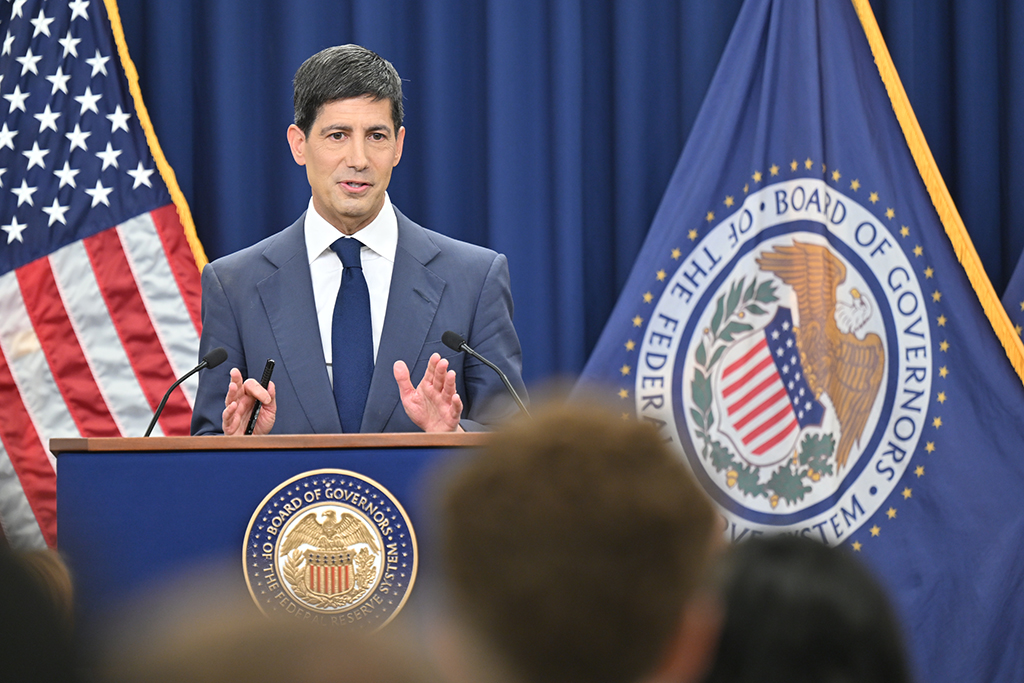
The policy decision is also shaping up to be a major test for new Fed Chair Kevin Warsh, whose approach to inflation has already attracted intense scrutiny.
Warsh has not committed publicly to a specific rate decision at the September 15-16 meeting.
But he has repeatedly indicated that the Fed would need to raise rates if inflation failed to moderate sufficiently.
At the Fed’s annual conference in Jackson Hole last month, Warsh sought to reinforce his commitment to bringing inflation back to the central bank’s 2% target.
“Here is my standard: We must be confident that underlying inflation is moving to our objective, clearly and at sufficient speed,” he said. “Otherwise, we have work to do.”
The statement was deliberately broad, leaving Warsh room to respond to incoming data.
The latest CPI report makes that flexibility more difficult to maintain.
Warsh’s challenge will not simply be deciding whether to raise rates.
He will also need to build consensus among policymakers and provide investors with a clear explanation for the decision.
At the Fed’s July meeting, the central bank kept rates unchanged, but Warsh’s explanation failed to fully clarify how he intended to deliver on his commitment to bring inflation back to target.
That contributed to uncertainty over the future path of policy.
A hike next week could therefore help establish a clearer policy direction.
Failure to act, meanwhile, could leave investors questioning how seriously the new chairman is prepared to respond to persistent inflation.
“Following the August PPI and CPI data and what will be not a disinflation friendly PCE for the Fed not to hike rates at its next meeting would be a blow to its own credibility given clear pricing dynamics following comments by Fed Chair Kevin Warsh at Jackson Hole and other rhetoric by both hawks and doves across the central bank in its aftermath,” said Joseph Brusuelas, Chief Economist at RSM US.
Fed remains divided over inflation outlook
There is already a group of policymakers arguing that interest rates are not sufficiently restrictive to bring inflation back to 2%.
Their argument is that higher rates would not only reduce demand but also prevent inflation expectations from becoming unanchored.
The opposing view has been that inflation would naturally moderate during the second half of the year, allowing the Fed to remain patient.
John C. Williams, president of the Federal Reserve Bank of New York and vice chair of the policy-setting committee, has argued that monetary policy is currently in a “good place”.
But Williams has also indicated that he would support higher rates if incoming data failed to show continued progress on inflation.
Christopher Waller, another Fed governor, similarly said he was inclined to keep rates unchanged next week if inflation continued to cool.
August’s figures have complicated that position.
Trump tensions raise the stakes
A rate hike would also carry political implications.
The decision comes only months before the election and could increase tensions between the Fed and President Donald Trump, who has repeatedly pushed for lower borrowing costs.
Last week, Trump threatened to halt a broad swath of US trade unless the Fed cut rates.
A rate increase would move in precisely the opposite direction.
For households, the timing is particularly difficult.
Consumers are already facing high prices, elevated borrowing costs and the potential for another wave of energy-related inflation as the Iran conflict pushes oil prices higher.
“Persistently high prices have weighed especially heavily on middle- and lower-income households, many of which are struggling to afford basic necessities,” said Mark Hamrick, an economic analyst and founder of The Hamrick Brief, in a previous CNBC report.
The Fed therefore faces a difficult balancing act: raising rates could put additional pressure on borrowers and households, while holding them steady could allow inflation to remain above target for longer.
Treasury and Fed goals diverge
The policy debate is further complicated by efforts from the Trump administration to reduce borrowing costs through the Treasury market.
Treasury Secretary Scott Bessent has spent recent weeks attempting to put downward pressure on long-term Treasury yields, including through Treasury buybacks.
The strategy has had limited success, with the 10-year Treasury yield trading just below 5%.
That creates an apparent tension between the Treasury’s desire for lower long-term borrowing costs and the Fed’s potential move toward higher short-term rates.
Bessent has rejected suggestions of a confrontation with Warsh.
“They want to set up Scott Bessent versus Kevin Warsh — that was rubbish,” Bessent said in an interview with Steve Bannon this week.
“Kevin and I have known each other for 20 years. To think that I don’t know what the chair of the Fed’s thinking is is absurd.”
Still, the contrast in policy objectives is difficult to ignore.
The Treasury wants to contain financing costs, while the Fed’s primary responsibility is to restore price stability.
The post Hike or hold? Fed policy meet next week to test Kevin Warsh's credibility appeared first on Invezz