
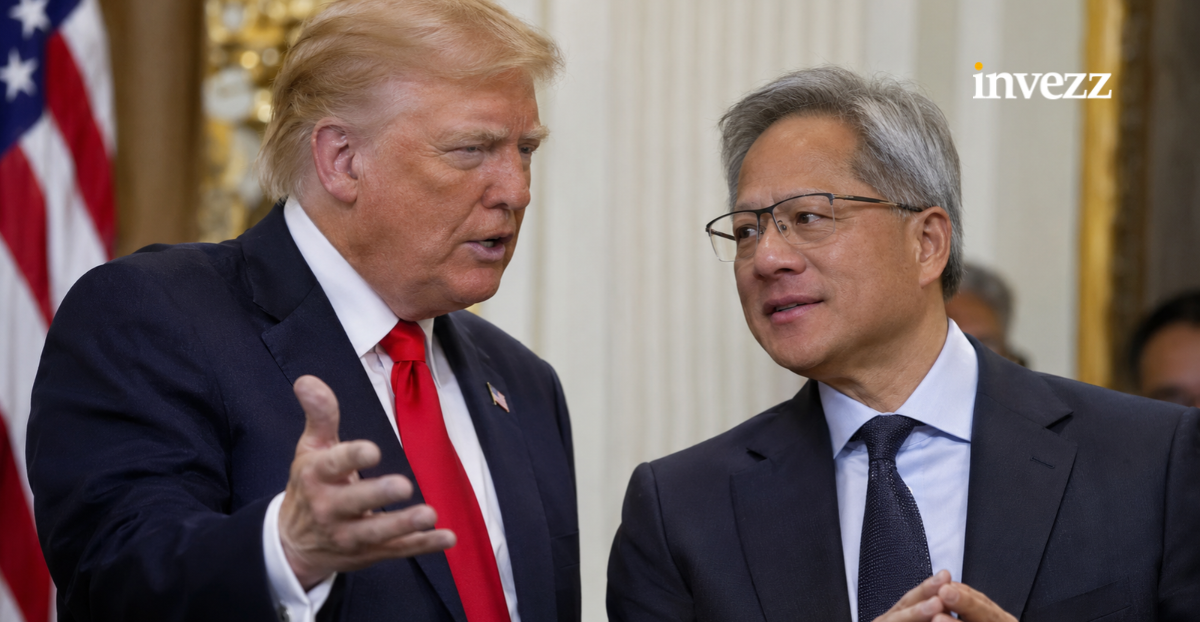
Nvidia shareholders face fresh uncertainty after President Donald Trump said he had considered a US government stake in the chipmaker and left open the possibility of pardoning its reinstated chief executive, Jensen Huang.
The remarks, made in a New York Post interview published after Tuesday’s stock market close, come as Washington’s influence over Nvidia’s leadership and export policies intensifies.
Nvidia stock (NASDAQ: NVDA) ended Tuesday at $155.38, down 5.86% after Monday’s 31.48% surge.
The decline preceded Trump’s latest comments, and neither government ownership nor a pardon has been agreed.
Intel’s government deal exposes a shareholder risk
Trump cited Intel as a precedent for possible government ownership. Washington agreed to invest $8.9 billion in the semiconductor manufacturer in August 2025 in exchange for a 9.9% stake, structured without board representation.
Yet Intel’s subsequent annual filing warned that issuing shares to the government diluted existing investors, reduced their voting influence and could complicate transactions or overseas relationships.
It also acknowledged that Washington’s interests might not always match those of ordinary shareholders.
The filing warned that foreign regulators might impose restrictions because Washington had become a significant shareholder.
The implications for Nvidia would depend on terms that have not been discussed publicly.
Buying existing shares would not directly dilute investors, while issuing new stock could reduce their percentage ownership and earnings per share.
A hypothetical 10% stake created entirely through new shares would expand the share count by roughly 11.1%, assuming no other changes.
JPMorgan’s Ron Adler warned that political interference could weigh on equity valuations, according to MarketWatch.
But he acknowledged another possibility: “The counterfactual is that this could support multiples for companies with strategic importance and close government ties.”
Nvidia stock today: A presidential pardon would leave other legal threats
Trump also told the New York Post that pardoning Huang was an option, although he did not expect it to be necessary.
The distinction matters because presidential pardons apply to federal offences. They cannot extinguish potential state-law violations or ordinary civil claims, according to the US Justice Department.
California Attorney General Rob Bonta subpoenaed Nvidia on 19 November while investigating whether advanced chips or confidential information reached China, and whether investors were misled.
Nvidia’s board has also said its independent inquiry will continue following Huang’s reinstatement. It created a national security and export-control committee and plans to appoint a chief compliance officer.
University of Southern California law professor Angela Zhang warned that corporate decisions increasingly shaped by presidential intervention risk making market confidence dependent on political discretion rather than predictable institutions, the Los Angeles Times reported.
Closer government relationships could help Nvidia navigate policy decisions, but they could also expose the company to changing political demands and prolonged scrutiny.
Nvidia stock price forecast
Nvidia’s underlying business remains exceptionally profitable. Fiscal third-quarter revenue reached $115.8 billion, up 103% annually, while the company returned $28.1 billion to shareholders through dividends and repurchases.
TipRanks’ $233.36 consensus target implies approximately 50% upside from Tuesday’s close.
Technology analyst Dan Ives raised his base-case target to $250, while retaining a possible $300 valuation if regulatory questions ease.
“You don’t add the $75 back right away,” he said in a CNBC interview.
The remaining challenge is separating Nvidia’s powerful earnings outlook from decisions that may be driven by politics rather than shareholders’ commercial interests.
Trump’s backing helped resolve the leadership crisis, but investors must assess whether deeper government involvement would create a more persistent risk.
AI disclosure: AI tools assisted with research and drafting of this piece. An Invezz editor reviewed the facts, sources and wording before publication. Any opinions or analysis are Invezz’s, not those of an automated system.
The post Why Trump's Nvidia plans could turn into a nightmare for shareholders appeared first on Invezz